Minimum wage and shorter working hours now!
Monday, 15 March 2010.
chinaworker.info
Mr So, 65, is just a few days from retirement. He still thought it important to join the Hong Kong Confederation of Trade Unions’ protest march for a minimum wage and an eight-hour working day. So works as a security guard and earns HK$6,800 per month for working four twelve-hour shifts every week. That brings his hourly pay to just under HK$33 (US$4.25) which is the level the HKCTU wants the new minimum wage to be set at. The Hong Kong government will introduce a statutory minimum wage this year, but details are still very much under wraps.
“I manage on my salary but then I’m single,” So told chinaworker.info. “If I had a family to support it just wouldn’t be possible on my salary.” Living in public housing, his rent is cheap by Hong Kong standards, HK$1,500 a month. On such a low income he is below the income tax threshold. His is just one example of the scandalously low wages paid by money-grabbing employers in Hong Kong. “The rents are so high in Hong Kong, that employers don’t want to pay higher wages,” he told chinaworker.info. A handful of property tycoons with close links to government exercise a strangle-like grip over the economy. Commercial rents for offices and shops are among the highest in the world.
No to a “fake” minimum wage!
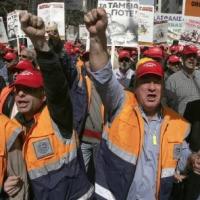
The HKCTU protest on 14 March, which drew around 200 participants, was one of several recent actions to raise the pressure upon Donald Tsang’s government to set the level of the new statutory minimum wage at a level at which workers can support a family. Unfortunately, the outlook is not hopeful for low paid workers. Massive struggle will be needed in coming months to prevent the government presenting yet another policy “fake”, this time a “fake minimum wage”.
Having resisted all thought of a minimum wage for years, the government reluctantly bowed to public pressure by establishing a commission to ‘look into’ the issue. This is a classic filibuster tactic – chinaworker.info could suggest a much quicker, more accurate way to get the facts about low pay, by going directly to the workers themselves. The Provisional Minimum Wage Commission (MWC) is stuffed with capitalists including fast-food sector bosses who pay the lowest wages of any employer in Hong Kong. Giving them such a role in the coming minimum wage law is like appointing Usama bin Laden to a commission on ‘homeland security’.
Business groups are lobbying hard to effectively kill off the new statutory minimum wage by setting it so low that the effects are minimal. The Hong Kong General Council of Commerce warns that even a minimum wage of HK$5,000 (US$645) a month, which is HK$24 (US$3.09) an hour based on eight hours a day, 26 days a month, could push unemployment up by 100,000, i.e. to double today’s level. University of Hong Kong demographer Dr Paul Yip Siu-fai told the South China Morning Post (22 February) that this argument was a fallacy. “The wages of low paid workers constitute only a tiny fraction of the operating cost of many companies,” he explained. Consequently, he argued, a minimum wage resulting in a pay rise for the lowest paid would have “a very limited cost-effect”. He also pointed out that these workers were not simply extra pairs of hands that could be dispensed with as the General Council of Commerce implies.
It was recently revealed that catering workers at seven public universities in Hong Kong are also paid ‘peanuts’. A survey by the Catering and Hotels Industries Employees General Union in October found the average pay for these workers was just HK$23.90 an hour and the average working day was 9.7 hours! Two years ago a similar survey found that hourly pay was HK$23.60 and average working hours were 9.6 for these workers. Catering workers are no longer directly employed by the universities, which are public bodies, but these and other services have been outsourced to private companies. At Lingnan University the cafeterias are outsourced to Asia Pacific Catering Corp, which is a subsidiary of fast-food chain Cafe de Coral. The bosses excuse rock bottom wages paid to university canteen staff pointing to the going rate in the fast-food sector with whom they are now “market-compatible”. The executive chairman of Cafe de Coral is Michael Chan Yue-kwong, who sits on the nine-member Provisional Minimum Wage Commission. This fact alone is a warning of how little is likely to come out of the commission.
HK$33 – just the beginning
“Minimum wage – to support a family on” was one of the main demands on the 14 March protest. Women workers wore tee shirts with the McDonald’s golden arches proclaiming “working poor”. The HKCTU is demanding HK$33 an hour as the benchmark for the statutory minimum. While this would be a step forward from today’s abysmally low level, it is nowhere near enough. A government survey shows that at HK$33 an hour, only 38 occupations out of more 220 covered by the survey would receive an increase. It is clear that the trade union leadership are setting the ‘bar’ too low. The HK$33 figure should in fact be regarded as the “insult-line” – anything less than this must be met by massive protests. Socialists and chinaworker.info argue the minimum level should be set at HK$45 to reflect the real cost of living in Hong Kong and especially sky-rocketing housing costs.
Hong Kong’s low pay scandal exposes the rottenness of capitalism. It is after all the third richest city in Asia and one of the richest in the world. According to the IMF (2009) measured by per capita GDP, Hong Kong’s economy is seventh richest in the world, ahead of Australia, Britain and Sweden for example. But while Hong Kong’s gross domestic product (GDP) expanded by 27 percent from HK$1.318 billion in 2000 to HK$1,677 billion in 2008, median monthly income only nudged ahead from HK$10,000 to HK$10,500 in the same period. This is the median figure i.e. including top bankers and other high-flyers whose salaries have gone stratospheric during this period. So the reality for more than one million low paid workers in Hong Kong has actually been falling wages in real terms. For socialists and chinaworker.info the issue is clear: If capitalism cannot afford to pay a decent wage upon which workers can make ends meet, then we cannot afford capitalism.
The struggle for a decent minimum wage must be stepped up and linked to a fighting programme against capitalism and for democratic public control and ownership of major companies to insure they pay a living wage. Privatisation, deregulation and outsourcing – all neo-liberal devices to lower wages – must be reversed. Demonstrations like that on 14 March are a good start but not enough in themselves. This should now be followed with a series of workplace meetings, mass leafleting and “naming and shaming” of low-pay employers, alongside a strategy to unionise low paid workers and prepare for struggle including strike action if the government fails to deliver.
HKCTU demonstration for minimum wage and shorter work hours, 14 March
Post comment
You must be logged in to post comments