China Worker
中文
 
 
这篇文章的中文版

The EU Project: Is it doomed?

Tuesday, 27 July 2010.

The eurozone is faced with a potential break up

Paul Murphy, Socialist Party (CWI Ireland)

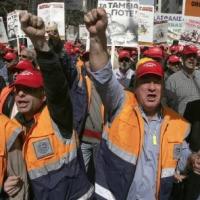
Currently, the governments of the so-called peripheral economies are determined to remain within the eurozone, and are trying to enforce savage austerity packages to ensure they can. However, whether they will be able to carry through the attacks demanded by the IMF and German capitalism is clearly in question when confronted with the massive movements of the working class as seen in Greece.
If they are not able to carry through these attacks successfully, these countries will certainly default and may well be pushed out of the eurozone through a combination of pressure of speculators and German capitalism, which is unwilling to "bail-out" other European economies. A very different eurozone than that which currently operates is a possibility - the common currency area could be reduced to the core countries of European capitalism.

The future direction of the European Union itself has also been put into question. A decisive shift in power within the EU took place in the course of the crisis. During the boom years, governments and capitalist classes in the European countries were happy to give power to the European Commission. The Commission, more removed from pressure than national governments, was able to largely successfully implement strategic measures across Europe in the interests of big business. The posting of workers' directive, for example, allowed migrant workers to be exploited across Europe.
However, as the crisis developed, key governments in Europe, in particular, Germany, have shown themselves unwilling to allow the Commission and central EU to make the key decisions in relation to the Greek crisis. Rather than Barosso and Trichet as the heads of the European Commission and the European Central Bank making the key decisions, Angela Merkel, the Chancellor of Germany, became the key figure.

Image 1178

No to EU Rail Privatisation


Regular trips to Berlin by the key figures in the crisis symbolise the shift of power away from centralised institutions back towards national capitalist classes. The dreams of those who envisaged a "federal Europe" akin to the US have been dashed against the reality of the increasingly divergent interests of the European capitalist classes. Instead, while the EU will continue for the moment, it will increasingly be riven by tension between these national capitalist interests.


Post comment

You must be logged in to post comments

See also:

Image 1524


Receive regular updates from chinaworker in your mailbox

English articles
Enter your email address:


Chinese articles
Enter your email address:

Support our struggle for a democratic socialist alternative in China