
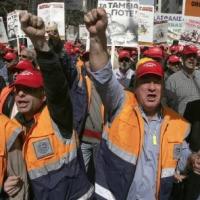
Unofficial demonstrations on Mao anniversary pose a dilemma for China’s rulers
Monday, 8 September 2008.
9 September is the anniversary of the death of Mao Zedong
chinaworker.info
This year on 9 September it is 32 years since the death of Mao Zedong. As last year, thousands of people, and significant numbers of students and young people, will gather in Beijing, Tianjin, Guangzhou, Zhengzhou and other Chinese cities. At last year’s events they sang songs from the Mao era, offered wreaths to Mao’s statue, wrote articles in his praise and condemned the government in his name. These commemorative demonstrations and ceremonies are unofficial, organised by informal networks outside the structures of the ex-Maoist ruling party. And while they often take place under the passive gaze of the security forces, they are something of a problem for the government. Mostly in an indirect form, these celebrations of Mao’s role are a reflection of the enormous dissatisfaction that exists among the masses with the reactionary and unjust policies of the current regime.
The 9 September mobilisations must be seen against the background of the last year: the multi-billion-dollar Olympic circus, May’s devastating earthquake, the Tibetan and Muslim-Uighur revolts of past months. These and other developments have been exploited by the government to whip-up pro-regime nationalism. The turnout at this year’s Mao commemorative events will therefore provide a measurement of how far the government’s nationalist propaganda in support of its anti-working class policies has effected the popular mood. Most Maoist-influenced youth were critical of, or opposed the Olympics, as did we. Chinaworker.info however adopted an internationalist and working class critique of the Olympic project. We completely reject nationalist arguments for or against the Games, using class arguments instead – the Olympics, organised by a coalition of the Beijing regime and global capitalism, trampled on the interests of workers and the poor.
New mass protests
Socialists will therefore be paying close attention to the size and character of the 9 September commemorative events. But another, even bigger, sign of the limits of official propaganda, and the fact that the Olympic spectacle has not led to any significant stabilisation of Chinese society, is the eruption of large-scale clashes of protesters and police in recent days in Jishou (Hunan), Ningbo (Zhejiang) and Shenqiu county (Henan). The numbers of youth, workers, unemployed and farmers involved in these separate flash-points possibly ran to more than 100,000.
The forces of the left in China began to revive in the latter half of the 1990s. As capitalism is reviving across the entire spectrum in China and neo-liberal globalisation is marching deeper and deeper into the country, left intellectuals and a layer of city workers began to look back approvingly upon the period of the old deformed workers’ state, as an expression of their desire for socialism and the urge to resist capitalism.
To this day, Maoism has important roots in Chinese society, based on the great social achievements of the 1949 revolution led by Mao, despite the bureaucratic and undemocratic Stalinist methods that characterised his regime. While, since the introduction of the ”reform and opening” policies of Deng Xiaoping thirty years ago, the CCP ruling elite have completely abandoned the ”old communist ideologies” in practise, they still hold up Mao as a ”dead idol” to be worshipped. ”The sun and the moon have already been changed into a new heavens”, but the old Mao portrait is still looking over Tiananmen Square today.
Particularly from the mid-90s, China has seen massive waves of unemployment, the rural unrest, the selling-out of state enterprises, the ever-widening gap between rich and poor, and the return of social scourges such as prostitution and drug abuse. Today’s Maoist currents have developed in reaction to these phenomena, rooted in the pro-capitalist policies of the last period. The Maoists today consist of three generations: the old born in the ’40s, the middle-aged born in the ’60s, and the youth born in the ’80s and ’90s. In addition there is a ”left-turning” layer of academics and officials – those who lost out in the intra-party struggles of the CCP (communist party) after the 1980s, who also use Maoism as a tool to attack CCP leadership.
Since the 1990s, there has been a noticeable upsurge in Mao memorabilia and nostalgia for the past, but mainly in the media, on the internet, and the wearing of old-style Maoist clothes and badges, hanging Maoist portraits in the home, replaying Maoist-era drama, reprinting Maoist books, and even eating Mao’s favourite dishes! This personal fixation with Mao, however, also underlines another political limitation of this trend – it has not really achieved anything concrete, and above all, it has rarely sought to link-up with or support actual workers’ struggle (against sweatshop conditions, job losses etc).
Maoists arrested
In 2005, four old Maoists from the city of Zhengzhou in Henan province produced leaflets protesting indignantly against the corruption of the government. As a result they were jailed for several years for ”spreading false accusations”. At the end of 2007, the Luoyang city government in Henan province openly dismantled the tombs of the revolutionary martyrs. This was done in order to provide space for commercial developments, and the remains of the martyrs were simply massed together in an extremely insensitive manner. After this travesty, the Maoists organised protests leading to the local government making a show of punishing those responsible. But what had already happened could not be reversed. Such events, however, have gone a long way to radicalise a large number of Maoist-influenced youth and older workers. Through this they have acquired a clearer understanding of the class nature of the policies being pursued by national and local governments today.
But in order to successfully fight against today’s capitalist policies this is not enough. No section of the current CCP stands for the interests of the workers and the oppressed. The differences within various factions and layers of this party centre on how, and at what speed, to attack the working class and continue to present ”reform” policies. For the working class and the rural poor a new party and in the first instance new fighting and independent trade unions are needed to fight back against these injustices.
Lessons of history
While we share the righteous indignation of today’s contemporary Maoists against the oppression of the dictatorial regime and the capitalist restoration, to simply return to the old Maoist ideology is not the way forward for the working masses of China. The lessons of history have shown the failure of Maoist rule, which because of its bureaucratic nature, without the active and democratic intervention and control of the working class, could not prevent the slide backwards to capitalism. The seeds of Deng’s policies were sown already in the preceding years before he came to power, flowing from the deepening crisis of the Stalinist bureaucratic system not just in China but also in the USSR and elsewhere.
Genuine socialism can only be realised through the renewed struggles of the working class against capitalist exploitation and autocratic oppression in China, but crucially also internationally, actively linking up with the struggles of working people in Africa, Europe and America, and building a common movement with common socialist goals. This movement must be a bottom-up, democratically controlled movement with leaders and representatives elected and subject to immediate recall, without privileges, living on the same wage as the average worker.
China’s young socialists, together, let us struggle for genuine socialism!
chinaworker.info
This year on 9 September it is 32 years since the death of Mao Zedong. As last year, thousands of people, and significant numbers of students and young people, will gather in Beijing, Tianjin, Guangzhou, Zhengzhou and other Chinese cities. At last year’s events they sang songs from the Mao era, offered wreaths to Mao’s statue, wrote articles in his praise and condemned the government in his name. These commemorative demonstrations and ceremonies are unofficial, organised by informal networks outside the structures of the ex-Maoist ruling party. And while they often take place under the passive gaze of the security forces, they are something of a problem for the government. Mostly in an indirect form, these celebrations of Mao’s role are a reflection of the enormous dissatisfaction that exists among the masses with the reactionary and unjust policies of the current regime.
The 9 September mobilisations must be seen against the background of the last year: the multi-billion-dollar Olympic circus, May’s devastating earthquake, the Tibetan and Muslim-Uighur revolts of past months. These and other developments have been exploited by the government to whip-up pro-regime nationalism. The turnout at this year’s Mao commemorative events will therefore provide a measurement of how far the government’s nationalist propaganda in support of its anti-working class policies has effected the popular mood. Most Maoist-influenced youth were critical of, or opposed the Olympics, as did we. Chinaworker.info however adopted an internationalist and working class critique of the Olympic project. We completely reject nationalist arguments for or against the Games, using class arguments instead – the Olympics, organised by a coalition of the Beijing regime and global capitalism, trampled on the interests of workers and the poor.
New mass protests
Socialists will therefore be paying close attention to the size and character of the 9 September commemorative events. But another, even bigger, sign of the limits of official propaganda, and the fact that the Olympic spectacle has not led to any significant stabilisation of Chinese society, is the eruption of large-scale clashes of protesters and police in recent days in Jishou (Hunan), Ningbo (Zhejiang) and Shenqiu county (Henan). The numbers of youth, workers, unemployed and farmers involved in these separate flash-points possibly ran to more than 100,000.
The forces of the left in China began to revive in the latter half of the 1990s. As capitalism is reviving across the entire spectrum in China and neo-liberal globalisation is marching deeper and deeper into the country, left intellectuals and a layer of city workers began to look back approvingly upon the period of the old deformed workers’ state, as an expression of their desire for socialism and the urge to resist capitalism.
To this day, Maoism has important roots in Chinese society, based on the great social achievements of the 1949 revolution led by Mao, despite the bureaucratic and undemocratic Stalinist methods that characterised his regime. While, since the introduction of the ”reform and opening” policies of Deng Xiaoping thirty years ago, the CCP ruling elite have completely abandoned the ”old communist ideologies” in practise, they still hold up Mao as a ”dead idol” to be worshipped. ”The sun and the moon have already been changed into a new heavens”, but the old Mao portrait is still looking over Tiananmen Square today.
Particularly from the mid-90s, China has seen massive waves of unemployment, the rural unrest, the selling-out of state enterprises, the ever-widening gap between rich and poor, and the return of social scourges such as prostitution and drug abuse. Today’s Maoist currents have developed in reaction to these phenomena, rooted in the pro-capitalist policies of the last period. The Maoists today consist of three generations: the old born in the ’40s, the middle-aged born in the ’60s, and the youth born in the ’80s and ’90s. In addition there is a ”left-turning” layer of academics and officials – those who lost out in the intra-party struggles of the CCP (communist party) after the 1980s, who also use Maoism as a tool to attack CCP leadership.
Since the 1990s, there has been a noticeable upsurge in Mao memorabilia and nostalgia for the past, but mainly in the media, on the internet, and the wearing of old-style Maoist clothes and badges, hanging Maoist portraits in the home, replaying Maoist-era drama, reprinting Maoist books, and even eating Mao’s favourite dishes! This personal fixation with Mao, however, also underlines another political limitation of this trend – it has not really achieved anything concrete, and above all, it has rarely sought to link-up with or support actual workers’ struggle (against sweatshop conditions, job losses etc).
Maoists arrested
In 2005, four old Maoists from the city of Zhengzhou in Henan province produced leaflets protesting indignantly against the corruption of the government. As a result they were jailed for several years for ”spreading false accusations”. At the end of 2007, the Luoyang city government in Henan province openly dismantled the tombs of the revolutionary martyrs. This was done in order to provide space for commercial developments, and the remains of the martyrs were simply massed together in an extremely insensitive manner. After this travesty, the Maoists organised protests leading to the local government making a show of punishing those responsible. But what had already happened could not be reversed. Such events, however, have gone a long way to radicalise a large number of Maoist-influenced youth and older workers. Through this they have acquired a clearer understanding of the class nature of the policies being pursued by national and local governments today.
But in order to successfully fight against today’s capitalist policies this is not enough. No section of the current CCP stands for the interests of the workers and the oppressed. The differences within various factions and layers of this party centre on how, and at what speed, to attack the working class and continue to present ”reform” policies. For the working class and the rural poor a new party and in the first instance new fighting and independent trade unions are needed to fight back against these injustices.
Lessons of history
While we share the righteous indignation of today’s contemporary Maoists against the oppression of the dictatorial regime and the capitalist restoration, to simply return to the old Maoist ideology is not the way forward for the working masses of China. The lessons of history have shown the failure of Maoist rule, which because of its bureaucratic nature, without the active and democratic intervention and control of the working class, could not prevent the slide backwards to capitalism. The seeds of Deng’s policies were sown already in the preceding years before he came to power, flowing from the deepening crisis of the Stalinist bureaucratic system not just in China but also in the USSR and elsewhere.
Genuine socialism can only be realised through the renewed struggles of the working class against capitalist exploitation and autocratic oppression in China, but crucially also internationally, actively linking up with the struggles of working people in Africa, Europe and America, and building a common movement with common socialist goals. This movement must be a bottom-up, democratically controlled movement with leaders and representatives elected and subject to immediate recall, without privileges, living on the same wage as the average worker.
China’s young socialists, together, let us struggle for genuine socialism!
Post comment
You must be logged in to post comments